How SMEs Can Turn Financial Data Into New Financing Opportunities with Embedded Financing
For many SMEs, financial data has traditionally served one primary purpose: bookkeeping, tax compliance, and preparing financial statements.
Today, that role is changing. In today's digital economy, financial data has become much more than a record of past transactions.
It has become a strategic asset that can help businesses improve decision-making and explore different financing opportunities through embedded financing.
Key Takeaways
As SMEs increasingly adopt digital accounting and business management solutions, they are gaining access to real-time financial insights that were once available only to larger enterprises.
At the same time, the rise of embedded financing is transforming how businesses access funding, making financial support more closely connected to actual business performance and data.
Together, these trends are reshaping how SMEs approach financial decision-making.
Why Financial Data Has Become a Business Asset
SMEs are the backbone of Malaysia's economy. According to the Department of Statistics Malaysia (DOSM), MSMEs contributed RM652.4 billion, or 39.5% of Malaysia's GDP in 2024.
Despite their economic contribution, many SMEs still face challenges when seeking financing. Traditional financing often requires businesses to prepare extensive financial documents, provide historical records, and undergo lengthy assessments.
However, as accounting and business management systems become increasingly digital, financial information is becoming more structured, timely, and transparent.
Instead of relying solely on manually prepared documents, businesses can maintain an ongoing digital record of their financial health through information such as:
This creates a more complete picture of how a business operates over time.
The Financing Challenge for Growing SMEs
Many SMEs don't struggle because they lack business opportunities. In fact, the challenge often comes when opportunities arrive before they have enough cash on hand to act on them.
For example, you may receive a large customer order but need to purchase more inventory first. Or you may want to invest in new equipment to increase production, or hire new employees to support business growth.
These are positive signs that your business is growing, but they also require additional funding.
Without sufficient working capital, many businesses are forced to delay the expansion or pass up opportunities altogether.
This is a common challenge faced by SMEs around the world. According to Bank Negara Malaysia, financing outstanding to SMEs accounted for 48.7% of total business financing as of June 2024, reflecting continued support for the sector. However, many smaller businesses still face challenges in accessing financing, particularly during their early growth stages or when immediate working capital is needed.
The challenge isn't just about finding financing. It's about being able to access it when the opportunity arises.
What Is Embedded Financing and How It's Changing the Equation
Embedded financing is changing how businesses discover and access financing. It refers to financing solutions that are integrated directly into the digital platforms and business applications that companies already use.
Traditional Financing vs Embedded Financing
Traditional Financing
Embedded Financing
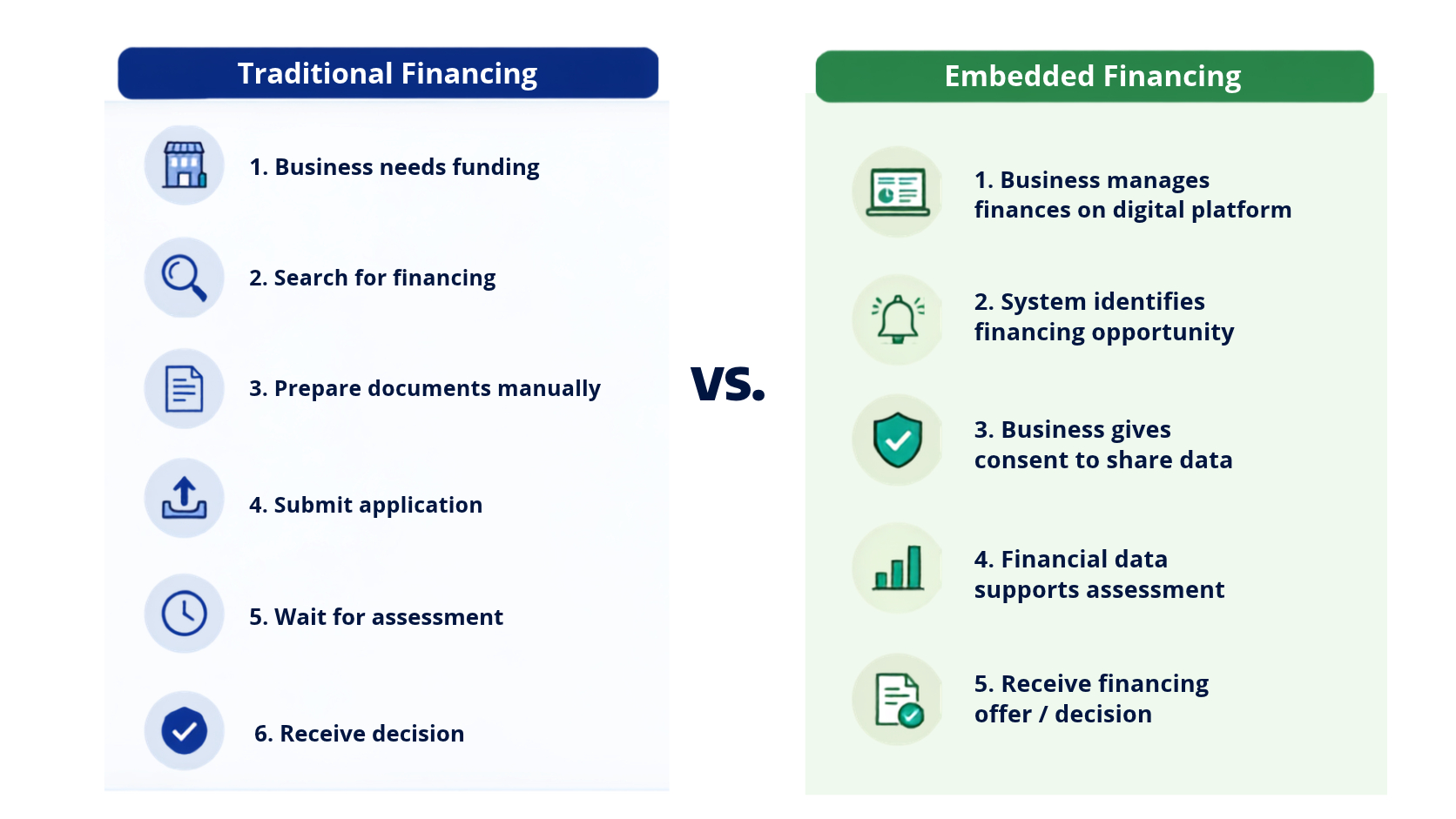
Source: Embedded Finance vs Traditional Financing
With embedded financing still gaining traction in Malaysia, it has already become a common offering in many countries. For example:
Rather than requiring businesses to leave their existing workflow and apply for funding through a separate process, financing opportunities can be presented within platforms where financial data already exists.
Importantly, embedded financing is about creating stronger connections between financial data, business performance, and financing decisions.
Turning Financial Data into Financing Opportunities
Financial data becomes significantly more valuable when it helps businesses act on opportunities instead of simply recording them.
Everyday business transactions can become valuable financial insights. With the business owner's consent, it can support financing assessments and help unlock new financing opportunities.
How Financial Data Supports Financing Opportunities
The process can be understood through six stages:
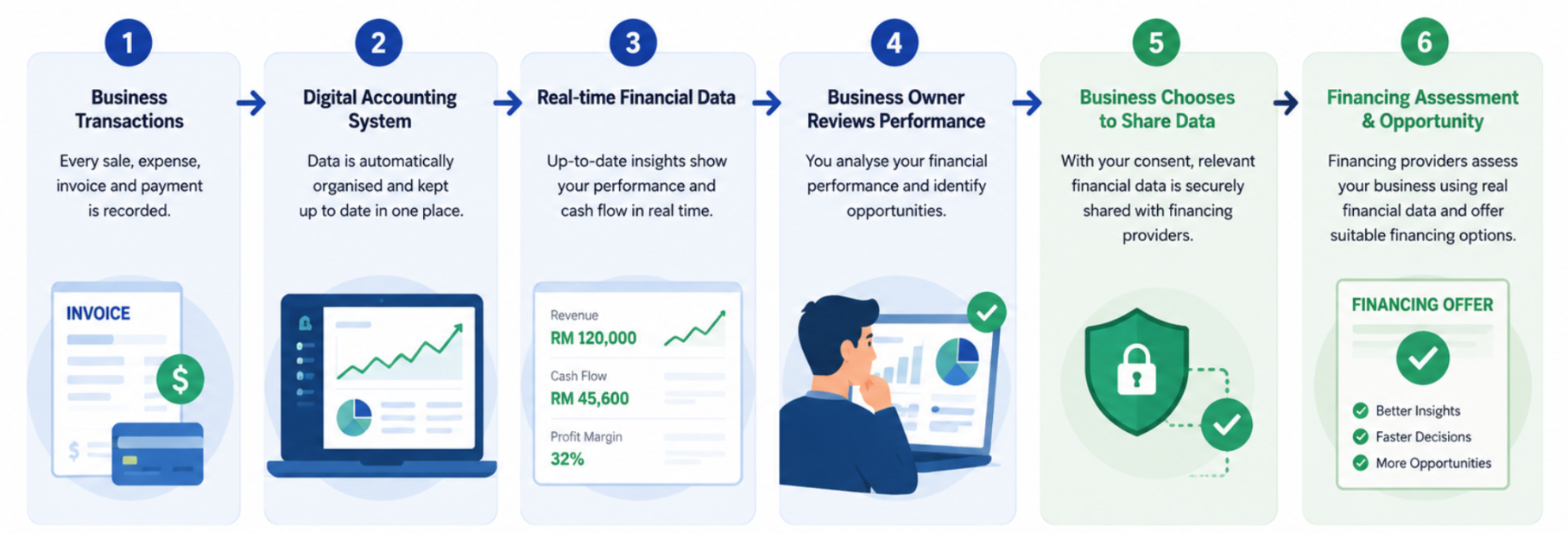
Source: Embedded Finance vs Traditional Financing
There are several ways SMEs can benefit from maintaining accurate financial records:
1. Demonstrate Business Performance More Clearly
Consistent financial records provide evidence of how a business is performing.
Steady revenue growth, healthy cash flow, improving profitability, and responsible payment behaviour all contribute to a clearer picture of business performance.
With the business owner's consent, these financial records can help financing providers make more informed assessments, while giving business owners greater confidence in their own financial position.
2. Respond Faster to Growth Opportunities
Business opportunities rarely wait.
Whether it is fulfilling a large customer order, opening another outlet, or investing in new equipment, timing often determines success.
When financial information is already organised and readily available, businesses can evaluate financing options more quickly without spending significant time preparing documentation.
This helps reduce delays between identifying an opportunity and taking action.
3. Improve Cash Flow Flexibility
Even profitable businesses experience temporary cash flow fluctuations.
Seasonal demand, delayed customer payments, or unexpected operating expenses can create short-term funding needs that disrupt healthy long-term performance.
By combining accurate financial data with embedded financing, businesses may have greater flexibility to manage working capital while maintaining normal operations.
4. Build Long-Term Financial Credibility
Every transaction recorded contributes to a more complete financial history.
Over time, consistent and accurate financial data can help businesses establish stronger financial credibility, making future financing discussions more informed and data-driven.
Rather than preparing financial information only when financing is needed, SMEs continuously build a financial profile through their day-to-day operations.
Building a Stronger Financial Foundation
While embedded financing offers new possibilities, the quality of financial data remains essential.
SMEs can strengthen their financial readiness by adopting several best practices:
These habits not only improve business decision-making but also create stronger financial visibility for future financing opportunities.
The Future of SME Decision-Making
The future of SME financing is becoming increasingly data-driven.
As embedded financing continues to evolve, businesses with accurate, real-time financial records may be better positioned to discover financing opportunities by securely sharing their data, with their consent, through the digital platforms they already use.
Note: Any sharing of financial or business data for financing purposes is done only with the business owner's explicit consent. Businesses remain in control of what information is shared, with whom, and when.
Financial data is no longer just about understanding what happened yesterday.
It is becoming a valuable business asset that can support future growth, improve financial resilience, and help SMEs unlock new financing opportunities when they matter most.
*This article is intended for educational and informational purposes. Businesses should consult with qualified financial advisors before making financing decisions.